Showing posts with label Yuma. Show all posts

Thursday, February 5, 2015

Marine Corps Base, Yuma, Arizona

  
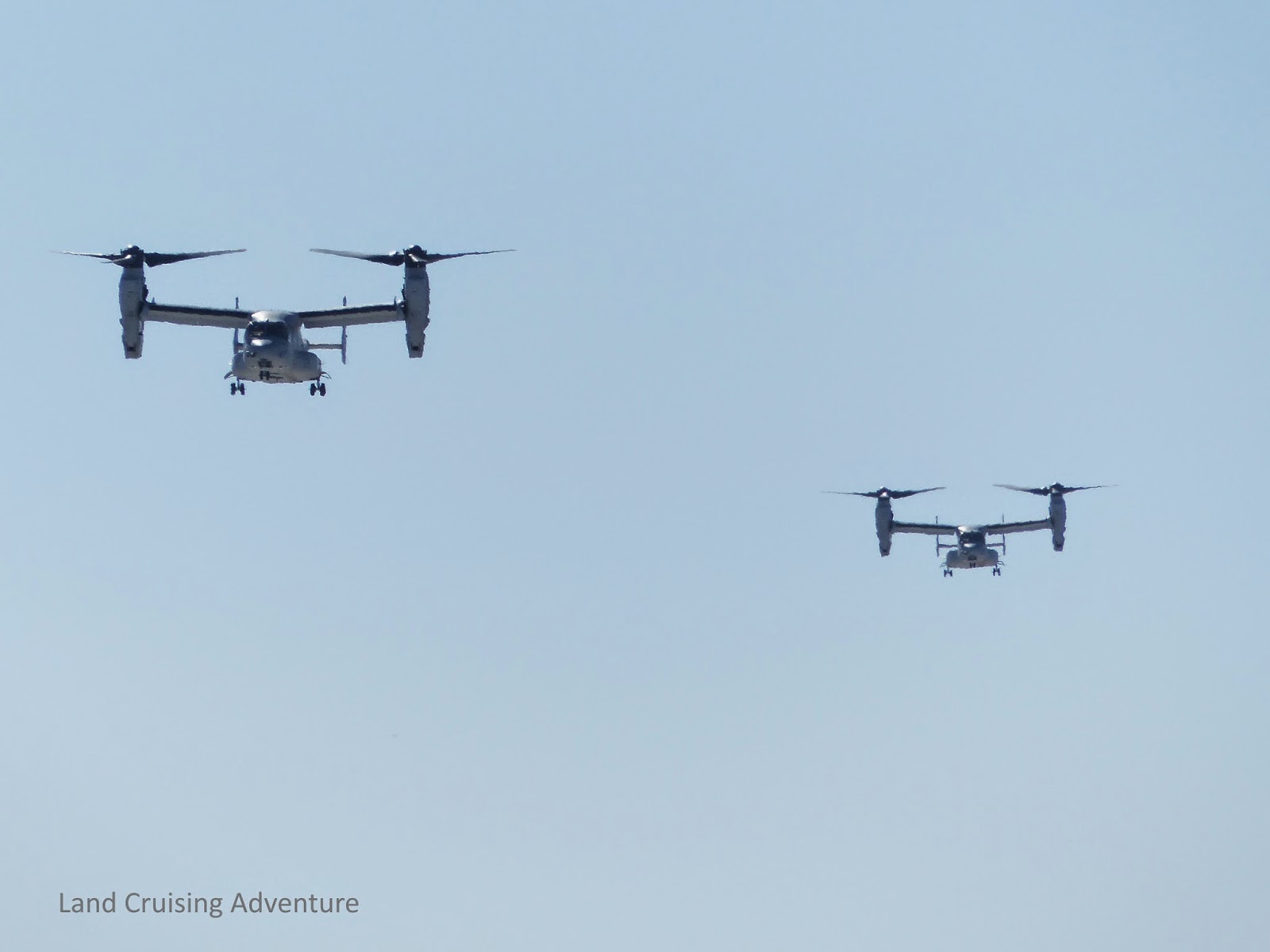
Sometimes, you just happen to be in the right place at the right time.   Today I was driving to the store and noticed quite a few vehicles in the parking lot of the fairgrounds just across from the airport of the Marine base here in Yuma, and everyone was staring across the street.  I looked to the other side and saw a couple of the aircraft shown above with rotors running, so I turned into the next entrance of the parking lot and grabbed my camera.  I take my camera with me almost everywhere I go - I might forget to bring the phone, but I have the camera.

 
As they approach to land, they look like they could be those little remote control toy planes - or would they be called helicopters - or would it be heliplanes.  Well, the mystery is solved, I sent a photo to my son, who is a pilot and he identified it as a Bell-Boeing V22 Osprey.  There is more on Wikipedia about them, even showing that their blades/props can be tilted forward to look more like a conventional airplane.
 

As I stood there waiting for them to come back to base, I saw this four-engine airplane.  Interesting enough, but not as intriguing as the other airships.
 
 
When you're traveling, you never know what you're going to see!


Wednesday, February 4, 2015

Peanut Patch and other fun.......

 
Yesterday I visited the Peanut Patch, which has been in Yuma, Arizona for years.  Yuma used to be a big peanut farming area, until the white fly came in and destroyed the crops.  Now, the Peanut Patch imports their peanuts from Texas and Oklahoma.  They have all kinds of nuts, plain and with coatings, as well as dried fruits and other candy.  By the way, this is not an advertisement, it was just a fun place to join the tour to see how peanuts are grown and prepared.  Then we got to see the kitchens where peanut brittle was being made!
 

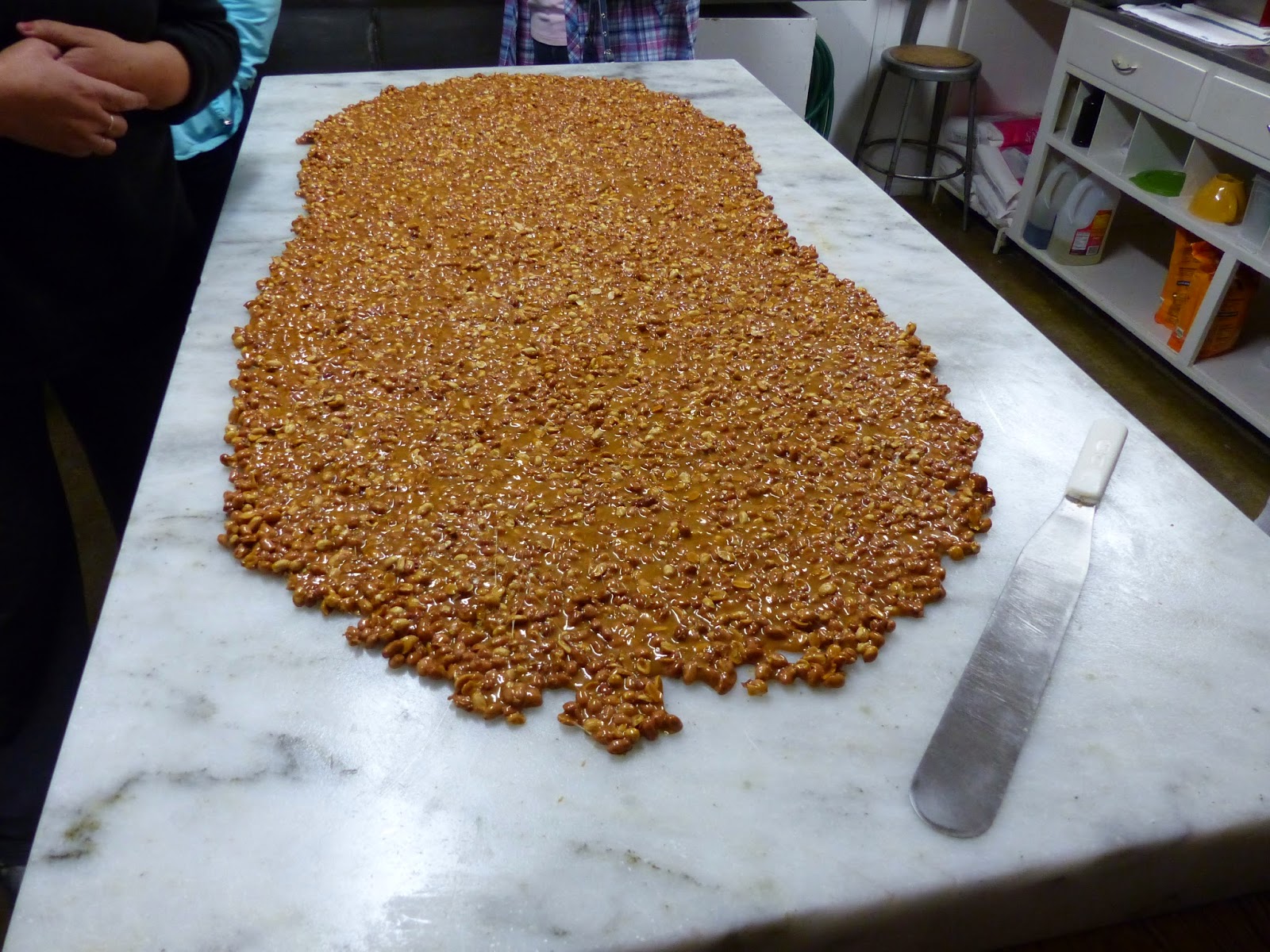
This is a piece of peanut brittle before being chopped up into smaller pieces for sale.  They make it in a huge copper pan and then pour it onto this marble slab that's about 3' x 5' and probably 6 inches thick.  It cools there quickly and then gets broken.  We also saw a huge pot of melted chocolate with peanuts being scooped onto sheets to harden up for candy.  As we left, we got samples of peanuts and fudge.  They also have ice cream -  cones or in a cup. 

As I left and headed home, I decided I should have more fun after lunch.  I almost never use my awning and decided I needed to clean it.  When I unrolled it, I could see that the dirt/mildew had gotten on various areas both on the top as well as the underside.  I had my bucket of soapy water and a soft brush on a telescoping handle that was just the right size for the job.  Doing the top part of the awning wasn't bad at all, but underneath, the water kept dripping on me and drooling down the handle of the brush and then down my arms.  Luckily, the weather here has turned warm.

So, now you know that RVing isn't all fun and games.  But I did spend some time in the pool and hot tub here this afternoon.  And then I had tamales delivered to my door by a Mexican man whose wife makes them - right in time for dinner.  Can't beat that!


Wednesday, January 28, 2015

Day Trip to Algodones, Mexico

 
I'm staying in Yuma, Arizona, but California is only a short ride across the Colorado River (not at all impressive at this point), and then you're automatically in a different time zone - they're an hour earlier than Arizona is.  There is a huge parking lot just on the State side of the border, owned by an Indian tribe, they have tourists parking there for $6 so we can visit this Mexican city.  They're making quite a nice little income from this huge parking lot.  There were hundreds of vehicles of all kinds in the lot today, including numerous RVs.  The tribe has posted signs prohibiting parking along the side of the road on the way in, even though there is plenty of space.  You can park on the road about a mile from the border, but most people don't want to walk that far.  And of course, there's always that warning about declaring all your money over $10,000 to Customs when you come back.  I've always wished I was well off enough to carry that amount of money with me for spending cash! 


I met up with another solo RVer who had been over to this border city, so it was nice to have a guide who knew somewhat where we were going.  She took me by her dentist's office so that I could get a card for future use - and for just in case.  It's always good to have a recommendation from someone who has actually been there - and was happy with the work.  We walked around town, looking at all the jewelry, blankets, backpacks and other items for sale.  They were bargaining heavily and kept giving us a lower price when we started walking away - one young man started at $50 for a blanket and kept lowering the price until he was at $15.  That was a great discount, but I decided I didn't really need it and didn't want to carry it around all day.  So, in these Mexican tourist towns, don't always expect to pay the price first quoted, and sometimes not the second or third, especially from street vendors.


After we got some items that we decided we needed, we had lunch at a busy restaurant that had outside tables surrounded by various shops.  Of course, we ordered Mexican food, and it was quite good. 

We had heard that crowds lining up to enter the States started lining up at the border in the early afternoon, so we were headed to Customs before the line got too long.  It was a fun day, I always like those trips to foreign countries. 

Monday, January 19, 2015

Bridge to Nowhere (McPhaul Bridge) near Yuma, Arizona


Today I set out to find a couple sites that were described in one of the tourist brochures for Yuma. The sign above is from the historic downtown area. There were antique shops, jewelry and clothing stores as well as other shops.  That was fun, but I wanted to find something more off-the-wall.

I wanted to find the Bridge to Nowhere that was built back in 1929 and then abandoned once it was built because it was judged to be "too flimsy". This bridge is an 800' suspension bridge to go over the Gila River, which has since been diverted. The bridge is now behind a farm store and surrounded by fields full of veggies growing.


I thought it was funny that I'd find another Bridge to Nowhere, since I had seen one that was built in St Thomas in the Virgin Islands. The one in St Thomas still hasn't been attached to anything on either side of it, and there are doubts that it will ever be connected, even though it is much more modern than the one I saw today outside of Yuma. Your federal tax dollars at work!

Yuma is a very agricultural area and there were fields full of produce ready to be harvested as well as fields that had been planted recently.


The most interesting field I saw was one with various colored "greens". I find it interesting that they went to the trouble to make it so symmetrically colorful.


So, that was my fun for today.  The weather has been great, sunny and in the high 70s during the day but cold at night still.   I'm ready for the weather to get warmer at night so I can move north to higher elevations.


Friday, January 16, 2015

Yuma Territorial Prison, Arizona


The other day, I went to prison again. The first time was Alcatraz in California some years ago, this time it was the Yuma Territorial Prison in Arizona. I committed no crime, it just happens that I like touring strange, unique places.

The Yuma prison was in operation for 33 years, from 1876 to 1909 and there was a total of 3,069 prisoners housed there during that time, including 29 women. The main cellblock was set up to hold 204 prisoners, but there had been times the population increased to 240. A 9' x 12' cell would hold 6 prisoners, bunks stacked 3 on each side of the cell. Prisoners were jailed for any type of cime from adultery and polygamy to murder and mayhem.

 
Punishment in the prison was sometimes a ball and chain or, in more extreme cases, the Dark Cell. The Dark Cell was a large room dug into the hillside with only a small vent built into the ceiling for air and light. Prisoners were put in an iron cell inside, in just their underwear. They were given no bedding and there were no restroom facilities. Depending on the severity of the infraction committed, the prisoner could be sentenced anywhere from one day to multiple days in the Dark Cell. One man spent 104 days straight in that cell, but when he was released back into the regular prison area, he turned out to be a model prisoner. The Dark Cell was not solitary and at one time, was occupied by 3 women prisoners.

Mug shots were taken of all prisoners and the photo below shows a special mirror that was used to show a side view as well as a front view.  The prisoner would sit in a chair, put his shoulder under the curved part of the frame on the bottom and the side of his face would be shown in the mirror and captured on film.  The mirror is reflecting a wood paneled wall in this photo. 


In 1887 there was an escape planned by 7 prisoners. This happened at the Sallyport, the main entrance to the cellbock areas, and has been known as the Gates Riot. Superintendent Gates was taken as hostage and he ordered the prison guards to shoot the prisoners. When it was all over, some prisoners were killed and the others were recaptured.


There was a hospital above the main cellblock, which include offices, operating rooms and ward rooms. Sometimes, prisoners from other areas would be transported to this hospital. At this time, nothing remains of this second story.


In 1910, a year after the prison closed, the Yuma High School was housed in the prison until 1914. At a football game one day, the opposing team started taunting the students, calling them "criminals". Instead of being insulted, the students decided that would be a great nickname for the team - and was sometimes shortened to "Crims". The high school team still goes by this name.

In 1923, the railroad tore down some of the buildings to build a new railroad bridge, which is still in use today.  These tracks are well used, I managed to catch photos of a couple different trains that went by while I was in the park.


From 1941 to 1960, the prison was a City Museum and then turned over to the State of Arizona to become the third state park. In 2010, the state was going to close the park, but the citizens of Yuma voted to take over the park, rehabilitate it and run it as a city park.  I'm glad they have been taking care of a piece of history because I enjoyed the tour.